Go global and become famous worldwide — Korean-style spicy cabbage
Baby cabbage leaves are brined whole, joined by diced radish, then coated with a fruit-rich chili paste for a version the whole family can enjoy.
Instructions
- 1
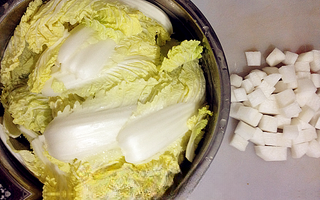
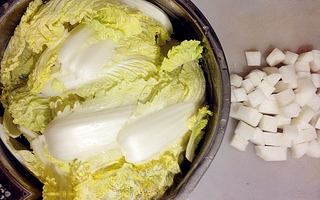
Clean the baby bok choy and separate it into individual leaves (you can choose napa cabbage, I was afraid of buying a bad one so I chose baby bok choy, but it actually tastes just as good). Since the leaves are small, there is no need to cut them, then soak them in water (for cleanliness). I also cut half a white radish~cut the white radish into 1.5 cm square pieces.
- 2
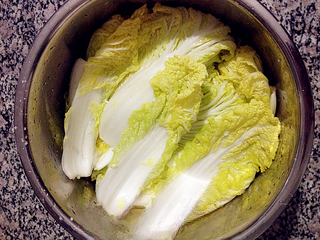
Prepare a bag of coarse salt, slightly drain the soaked cabbage, and find a container that can hold all the cabbage and radish. First, sprinkle a thin layer of salt, then place a layer of cabbage, sprinkle a little more salt evenly, then add another layer of cabbage, and continue in this manner until all the cabbage and radish pieces are placed. (If you don't have coarse salt, regular salt can also be used, but coarse salt is preferred because next you need to draw out water from the cabbage—coarse salt is specifically for this.) Then cover the cabbage with a sheet of plastic wrap and place a heavy object on top, keeping it in place for at least five hours.
- 3
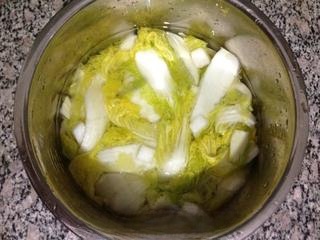
This is cabbage that has been pickled for an entire afternoon, very soft, and has released so much cabbage juice~ At this time, the cabbage is very salty, so you need to drain the pickled cabbage and radish, rinse them several times with clean water, and then fill the container with clean water to submerge the cabbage, which is also to remove the saltiness. Once this step is done, let the cabbage and radish soak in water, and then prepare the pickling spices.
- 4
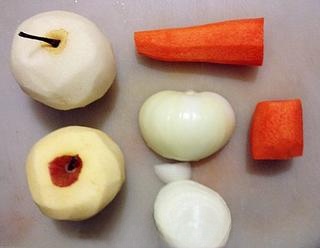
Prepare the fruits and vegetables, cut them into pieces, and put them into the blender to juice (note, it's juicing~). Do not omit the fruits, as they help with fermentation and will give the final product a fresh aroma; this is a sweetness that white sugar cannot replace~ Carrots are for coloring~ Onions are for enhancing the flavor~
- 5
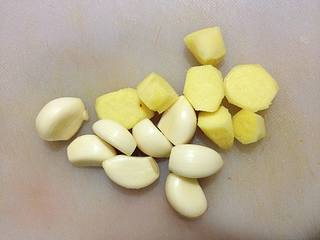
Peel the ginger and garlic and cut them into pieces, then continue to put them into the blender to juice. No need to separate from fruit and vegetable juice, just juice them together~ I’m just doing it for the photos~
- 6
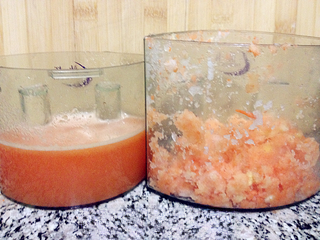
Place the squeezed seasoning juice and fruit and vegetable residue separately, and at this time take out the glutinous rice flour.
- 7
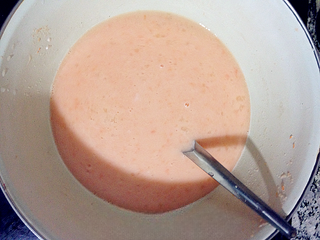
My personal secret weapon is here~~ It's definitely my own exclusive creation~ Mix glutinous rice flour and fruit and vegetable juice in a 1:10 ratio~ Note that it should be fruit and vegetable juice~ If you don’t have much juice, you’ll have to add some water; if you have enough, then just use all the juice~
- 8
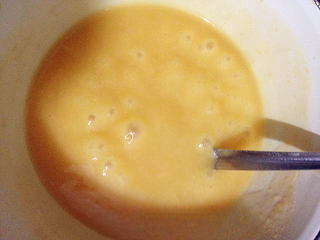
Place it on the stove, turn to low heat, and stir constantly to prevent sticking and burning. Turn off the heat when the glutinous rice paste starts to bubble vigorously and becomes very thick, as shown in the picture.
- 9
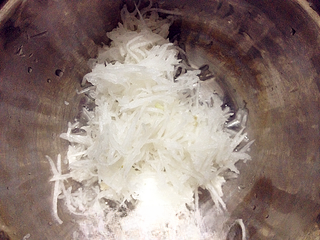
Set the glutinous rice paste aside to cool. Peel half a white radish and grate it into fine shreds~ When I usually make kimchi, I include the radish pieces together, because the kimchi seasoning sauce requires white radish shreds~ After grating, add an appropriate amount of salt to draw out the moisture, and after the moisture comes out, pour off the liquid.
- 10
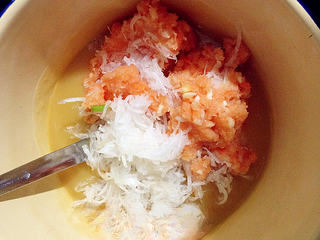
After the glutinous rice paste has cooled, add the freshly squeezed fruit and vegetable pulp and the pickled white radish shreds.
- 11
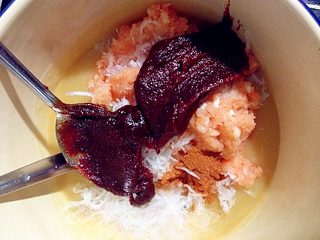
Add Korean chili paste (I used Huhu, the taste is good, and you don’t have to worry about adding too much~ you can add more) and fine chili powder. As you can see in the picture, I added very little chili powder because this chili powder is very spicy~ You can adjust the amount according to the spiciness of your chili powder. It is recommended to add a little first and then add more if needed after adjusting the flavor.
- 12
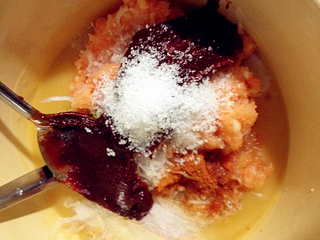
Add sugar and fish sauce
- 13
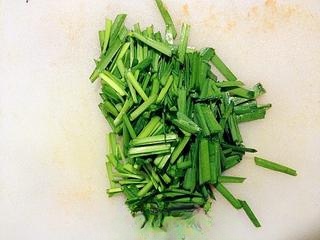
Remove the roots from the chives, wash them clean, and cut them into sections.
- 14
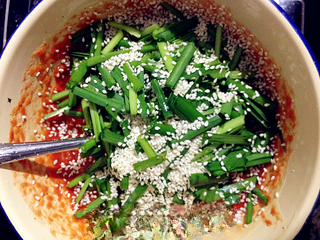
Add chopped chives, white sesame seeds, and a small amount of salt — just a tiny bit of salt. At this point, you should taste your cabbage. If the cabbage is just slightly salty, add a little less; if it is very salty, don't add any at all. Then, you need to soak the cabbage in plenty of water.
- 15
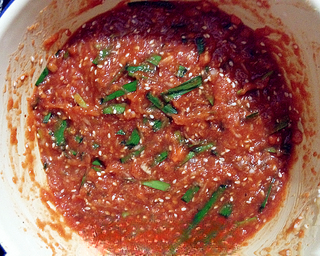
Mix all the ingredients evenly and taste it. At this point, the flavor should be pretty good~ If it's not sweet enough or not spicy enough, add more chili powder or sugar. If the garlic and ginger flavor is not strong enough, mince them into a paste and add~ However, be careful not to let the garlic and ginger flavors be too prominent~ The overall sauce should be a new flavor resulting from the combination of various ingredients~ The main taste is slightly sweet and spicy~
- 16
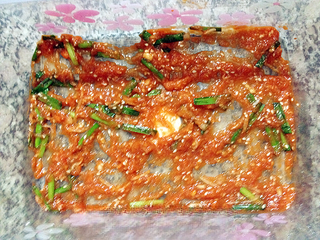
First, spread a layer of sauce at the bottom of the large storage container for the kimchi (make sure the storage container is sterilized in advance and is free of oil and water).
- 17
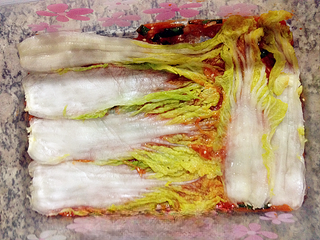
Squeeze the soaked cabbage to remove excess water and evenly spread it over the chili sauce, making sure every piece is coated with the sauce (when squeezing out the water, do it like wringing a towel, but be careful not to tear it).
- 18
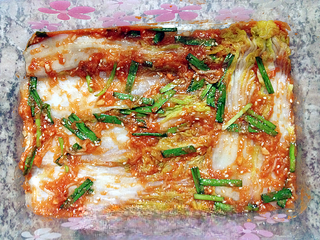
Evenly spread a layer of chili sauce on the cabbage
- 19
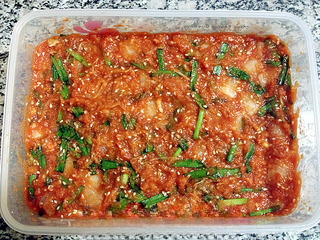
Lay all the cabbage in the same way, and whether to put the white radish pieces in first, last, or in the middle is entirely up to you. Make sure to squeeze out the water~ Spread a thick layer of spicy sauce on top~ This helps with fermentation~
- 20
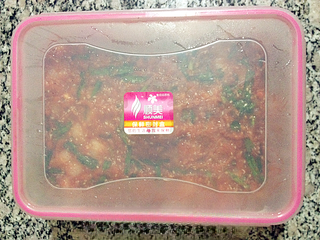
Cover the lid and ferment indoors. If it is winter, place it in a warm spot. In summer, leave it indoors for one to two days; in winter, three to four days. Wait until, when opening the box, there is a slight sour smell. Gently press the cabbage with the tip of a chopstick; if you can feel a certain space beneath the cabbage, and pressing it feels not solid but hollow, it indicates that the initial fermentation is complete~
- 21
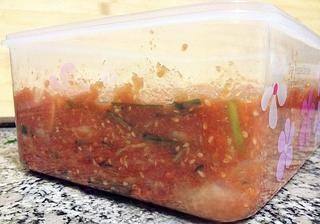
After the initial fermentation is complete, put it in the refrigerator, that is, refrigerate it~~ I don't like it to be too sour, I just like the taste when it has just fermented, so I usually eat it on the fifth or sixth day~ The longer it sits, the more pronounced the sour taste will be~ What flavor you like is up to you~
- 22
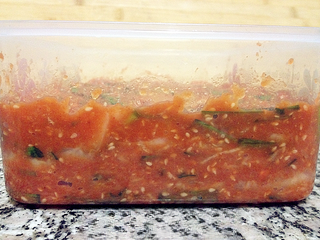
Side view of the storage container, the sauce must be enough for the slices to absorb the flavor~
- 23
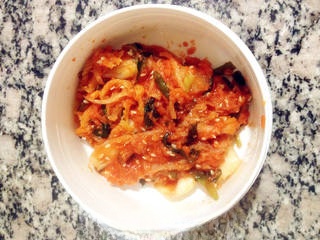
Finished product~ If there are guests, cut it into pieces to eat~ If there are no guests, just eat it in one slice~ Or eat it like Koreans, tearing it by hand~ Awesome! This is how great taste is born~ Absolutely can't stop eating~ With it, you can make a hundred kinds of kimchi dishes~
Video Sharing
Share your cooking video with others
No videos yet. Be the first to share!
Discussion
Ingredients
Main Ingredients
- Bok choy4 pieces
- Applemore than half
- Pear1 piece
- Garlica handful
- glutinous rice flourto taste
- Carrot1/2 piece
- chivesa handful
- white radish1 piece
- fish sauceto taste
Auxiliary Ingredients
- Fresh ginger1 large piece
- Scallion bulb1/2 piece
- white sesameto taste
Seasonings
- Korean spicy sauce2 tbsp
- Chili powderto taste
- coarse saltto taste
- Refined saltto taste
- white sugarto taste